

Blood Testing Explained
Finger Prick vs Venous Blood Tests: What’s the Difference?
A practical UK guide to the differences between finger prick and venous blood testing, including sample quality, biomarker choice, convenience, reliability and when each method makes the most sense.
At Origin Bloods, we provide venous-only private blood testing for men and women across the UK. This guide compares finger prick and venous blood collection so you can understand how sample type affects reliability, biomarker range and overall testing quality, and why venous collection is often the stronger option for broader and more dependable analysis.
On this page
What this guide covers
Why venous blood collection is often the stronger option for broader and more reliable testing
Understand the real differences between finger prick and venous blood tests so you can choose the method that fits your goals, your biomarkers and the level of reliability you want.
Introduction
When comparing finger prick vs venous blood tests, the most important point is that they are not simply two identical ways of doing the same thing.
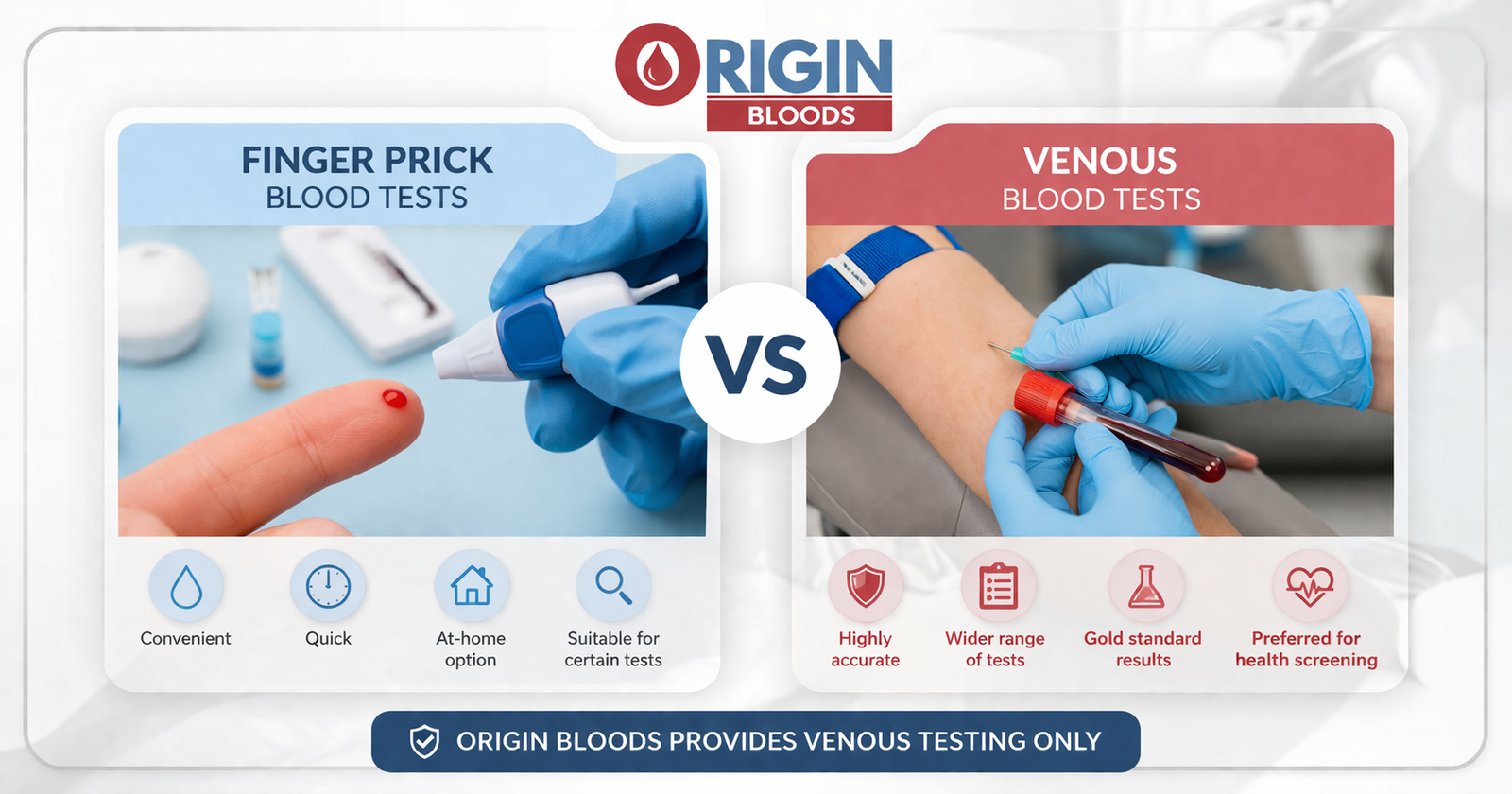
Finger prick testing uses a small capillary blood sample from the fingertip. Venous testing uses blood drawn from a vein, usually in the arm, by a trained healthcare professional. Both methods can be useful in certain situations, but they differ in sample size, collection quality, biomarker scope and overall practicality.
For people exploring how private blood tests work in the UK, this is one of the most useful distinctions to understand. Collection method is not just a technical detail. It can affect how broad the test panel is, how dependable the sample is, and how well the testing process fits your needs.
What is finger prick blood testing?
Finger prick testing uses a small lancet to collect blood from the fingertip. The sample is then transferred into a collection tube or onto a card, depending on the test and provider.
This method is often used for at-home testing because it avoids the need to attend a clinic or book a professional blood draw. That convenience is part of the appeal. For some people, it can feel like a simpler and more accessible way to test.
Home-friendly collection
Finger prick kits are often used at home without needing a clinic appointment.
Smaller sample volume
The amount of blood collected is much smaller than with a venous sample.
More limited testing scope
Some tests work well, but broader or more complex panels are often less ideal.
Finger prick testing can be convenient, but convenience is not the only factor that matters. Sample quality and the type of biomarkers you want to assess are just as important.
What is venous blood testing?
Venous blood testing involves taking blood directly from a vein, usually in the arm, using professional collection equipment and a trained healthcare professional.
Because the sample is larger and collected in a more controlled way, venous testing is often better suited to broader and more detailed analysis. This is especially relevant for hormones, nutritional markers, wellness panels and more advanced general health testing.
Professional collection
Venous samples are usually collected by a trained professional, which supports better consistency and handling.
Better suited to broader panels
The larger sample size often allows more biomarkers and more advanced testing panels to be analysed properly.
This is one reason many providers focused on higher-quality private testing prefer venous collection. It supports stronger sample integrity and is usually the better fit when wider biomarker choice matters.
Finger prick vs venous blood tests: key differences
The biggest differences usually come down to sample size, collection reliability, biomarker range and what each method is best suited to in practice.
Finger prick
Uses a small capillary blood sample collected from the fingertip.
Venous
Uses a larger blood sample taken from a vein, usually in the arm.
Finger prick
Self-collection can be less consistent and may lead to more avoidable sample issues.
Venous
Professional collection usually improves consistency and reduces avoidable sample problems.
Finger prick
Often more limited for wider panels and more complex analysis.
Venous
Usually better suited to broader panels including hormones, vitamins and wider health markers.
Finger prick
Best when simplicity and at-home convenience matter more than testing breadth.
Venous
Best when accuracy, broader biomarker choice and better sample quality are priorities.
Sample quality and collection reliability
One of the biggest practical differences between these two methods is sample quality. Finger prick testing depends on a small fingertip sample that is often collected by the person taking the test. That can introduce more variability in how the sample is collected, stored and returned.
Venous testing is usually more controlled. The larger sample and professional collection process can help reduce avoidable issues such as insufficient volume, clotting or collection inconsistency. That becomes particularly important when the goal is a broader panel or a more dependable overall result.
If you are trying to decide how to choose the right blood test, collection quality is one of the strongest factors to think about. Simplicity matters, but sample robustness matters too.
Biomarker range and panel choice
Finger prick testing can be suitable for some simpler checks, but venous collection is often more appropriate when you want access to a broader or more detailed panel.
This is especially relevant for hormones, thyroid markers, nutritional markers, broader wellness panels and more advanced general health testing. If you want a wider overview of what can be assessed, venous testing often provides more flexibility.
It can also help to understand what a blood test can check for and what blood test biomarkers mean, because the value of the collection method is closely tied to what you are actually trying to measure.
Convenience and practicality
Finger prick testing is often chosen for convenience. It can usually be done at home, which appeals to people who want a simpler process without attending a clinic or arranging a professional blood draw.
Venous testing is less DIY by nature because it usually involves a clinic appointment or a mobile phlebotomy visit. However, that extra step is often what supports the stronger sample quality and broader testing scope many people are looking for.
In simple terms, finger prick testing often wins on ease and speed, while venous testing often wins on sample strength and broader clinical usefulness.
When should you choose finger prick or venous testing?
Finger prick testing may make sense when convenience is the main priority and the test you want is suitable for a smaller capillary sample.
Venous testing often makes more sense when you want broader biomarker choice, lower sample failure risk, stronger collection quality or a more reliable overall testing experience.
This is also relevant when comparing NHS vs private blood tests in the UK, because people often choose private venous testing specifically for the extra flexibility and broader panel access it can provide.
Choose finger prick when
You want a simpler at-home process and the test you need is suitable for a small capillary sample.
Choose venous when
You want broader biomarker choice, stronger sample quality, professional collection and a more robust testing process.
Final thoughts
Finger prick and venous blood tests are not exactly the same. While finger prick testing can offer convenience and accessibility, venous testing is often the stronger option when you want broader biomarker coverage, better sample quality and a more dependable collection process.
The best choice depends on your goals. If convenience matters most and the test is suitable for a small capillary sample, finger prick testing may be appropriate. If you want broader analysis and a more robust sample, venous testing is often the better fit.
Helpful Information
Frequently Asked Questions
Learn more about finger prick and venous blood testing, including convenience, reliability, biomarker scope and when each method may make sense.
Are finger prick blood tests as accurate as venous blood tests?
Both methods can be useful, but venous testing is often preferred when broader analysis, stronger sample quality and lower collection variability are important.
Why do some providers prefer venous blood testing?
Venous testing provides a larger sample and usually involves professional collection, which can support more reliable handling and a wider biomarker range.
Is finger prick testing more convenient?
It often is, because it can usually be done at home. That convenience is one of the main reasons people choose it.
Can venous blood tests check more biomarkers?
In many cases, yes. The larger sample size often makes venous testing better suited to broader and more advanced panels.
Which is better for hormone testing?
Venous testing is often preferred for broader hormone panels because it usually supports better sample quality and a wider testing scope.
Should I choose finger prick or venous testing?
It depends on your priorities. Finger prick may suit simpler at-home testing, while venous testing is often better when you want broader panels and a more robust collection process.